February 2, 2026
For aircraft maintenance technicians, job security is not an abstraction. It is the difference between a career spent building mastery on complex aircraft systems and a pink slip issued when work is quietly shifted to a hangar thousands of miles away. In today’s airline industry — where outsourcing, foreign repair stations, and cost-driven labor strategies are accelerating — the question is no longer which union talks most forcefully about protecting jobs. It is which union has actually done it.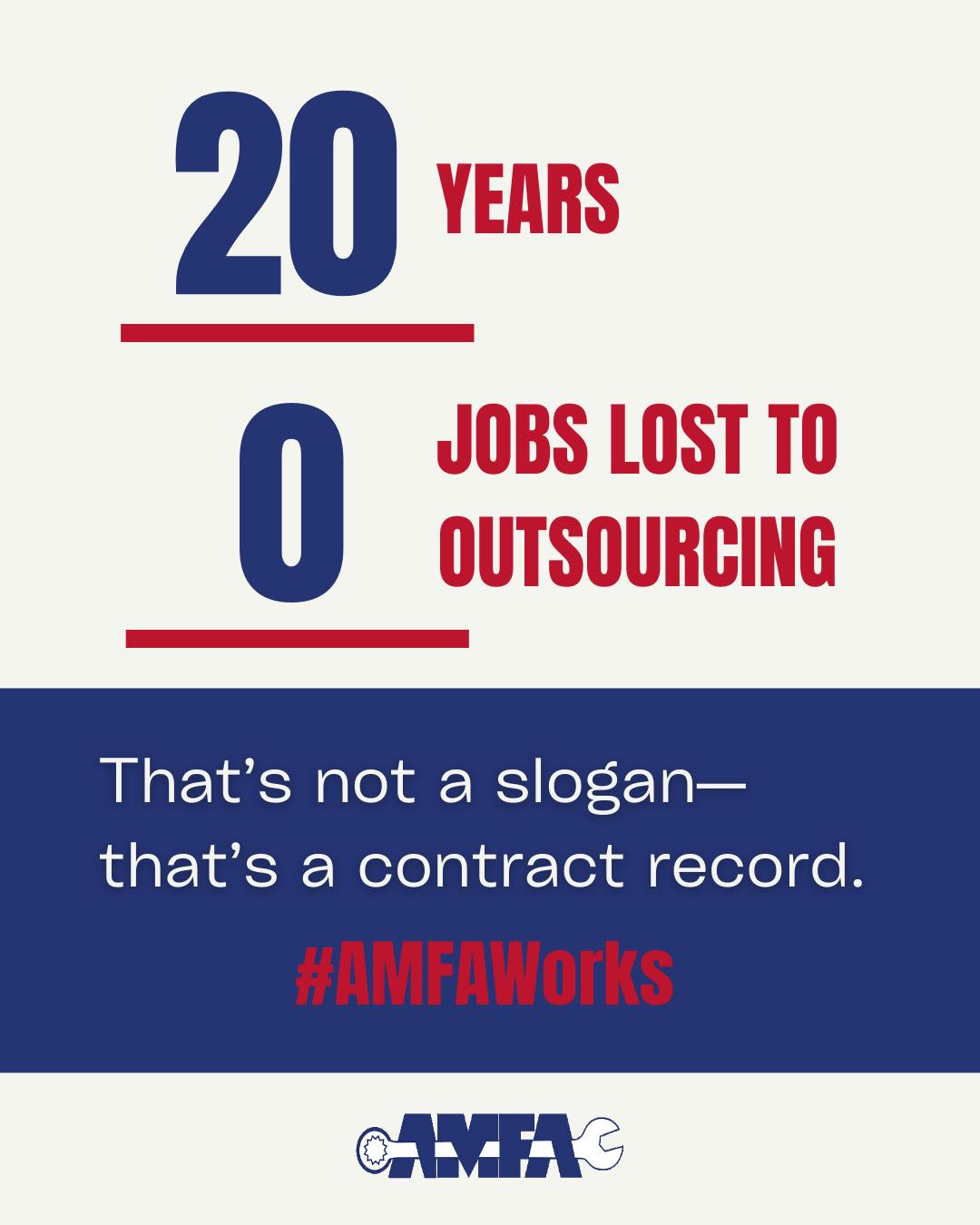
That distinction now sits at the center of the representation fight at the newly merged Alaska–Hawaiian Airlines. On one side is the Aircraft Mechanics Fraternal Association (AMFA), a craft-specific union that represents only aircraft maintenance professionals. On the other is the International Association of Machinists and Aerospace Workers (IAM), an industrial union with a long history in aviation — and an equally long record of presiding over the largest offshore shift of U.S. maintenance work in the modern airline era.
The contrast between the two is not ideological. It is measurable.
For more than twenty years, not a single AMFA-represented aircraft maintenance technician or engineer has lost a job as a direct result of outsourcing. That is not marketing language. It is the product of contract provisions that include enforceable scope clauses, strict limits on vendor use, and, critically, no-furlough and no-layoff protections that have been tested — and upheld — in arbitration.
When the COVID-19 crisis brought the airline industry to the brink, carriers sought concessions and issued furlough notices across the system. At Alaska Airlines and Southwest, AMFA invoked those protections and took the cases to expedited arbitration. The result: every furlough was stopped. No layoffs. No forced relocations. No erosion of maintenance work. At a moment when “job security” was no longer theoretical, AMFA’s language held.
The same period revealed a very different pattern under IAM and its partner union, the Transport Workers Union (TWU), at the nation’s largest carriers. American Airlines, represented by IAM-TWU, now operates extensive heavy-maintenance and component overhaul facilities in Brazil, El Salvador, Hong Kong, and Singapore. Entire categories of work — widebody checks, landing gear overhaul, engine maintenance, composite and plating shops — have been shifted abroad, even as domestic bases in Tulsa, Kansas City, Fort Worth DWH, Fort Worth Alliance, Fort Worth TASEL, Charlotte and Pittsburgh were downsized or closed, eliminating thousands of U.S. maintenance jobs.
At Hawaiian Airlines, where IAM currently represents technicians, the collective bargaining agreement (CBA) explicitly allows the company to outsource line and heavy maintenance at any station outside the state of Hawaii. The airline now sends A330 and A321neo heavy checks to Singapore and the Philippines and contracts mainland scheduled line maintenance checks to third-party vendors. These are not isolated decisions; they are the direct outcome of scope language that permits offshoring as a business strategy.
The structural difference between the two unions helps explain the divergence. AMFA is a single-craft organization. It represents only aircraft maintenance technicians, engineers, and related skilled professionals. Every negotiation, every resource, every political priority is focused on technicians and engineers protecting their work. Its national officers are directly nominated and elected by its membership. Negotiations are open to observers. Members receive full tentative agreements before voting and have visibility into every line of scope and outsourcing language that governs their future.
IAM, by contrast, is an industrial union representing workers across dozens of industries and sectors, from aerospace manufacturing to rail, shipyards, and public transit. Aviation maintenance is one constituency among many. Scope language is often negotiated centrally, ratified without full disclosure of side agreements, and, in major cases such as American Airlines, approved without a direct membership vote on the outsourcing frameworks that enabled long-term offshore commitments.
History underscores the impact of those models. At American Airlines, IAM- and TWU-represented technicians saw the steady migration of heavy maintenance and engine overhaul to foreign facilities over the past two decades, even as the unions and the company reported those operations as “in-house” by classifying foreign American Airlines employees under the airline’s payroll. The unions and company claim of 33% outsourcing cap and result was a statistical mirage that masked the largest sustained export of U.S. maintenance work in the industry.
At Alaska Airlines, the story followed a different trajectory after aircraft technicians replaced IAM with AMFA in 1998. While AMFA inherited IAM scope language that allowed certain outsourcing, AMFA over years of bargaining, successfully used collective bargaining and arbitration to secure, and enforced all noticed furlough employees with those no-layoff protections and to retain 100 percent of scheduled line maintenance and checks. When the pandemic arrived, those negotiated clauses proved decisive not only for Alaska Airlines members, but all three AMFAs agreements at Southwest Airlines aircraft technicians, aircraft cleaners and facility technicians had similar layoff protection language.
Job protection, however, is only one side of the equation. The other is economic power. AMFA’s contracts over the past decade have reset wage standards across North America: the landmark Southwest agreement that delivered more than 20 percent raises and $160 million in retroactive pay; Alaska’s 2024 contract establishing an industry-leading top-of-scale rate, automatic annual increases and wage review; WestJet’s first collective agreement after a successful strike, producing 27 percent raises and a secured 20 percent employer retirement match; and recent deals at Horizon, Jazz, JTS, Calm Air, and Sun Country, all featuring double-digit gains and strengthened scope.
Those agreements have had a cascading effect. According to Bloomberg Law, AMFA’s Southwest contract alone drove a nationwide increase in union-negotiated maintenance wages. Membership has grown by more than 80 percent since 2018, fueled by technicians who see a union that pairs top-of-market pay with enforceable control over where their work is performed.
The political dimension reinforces the pattern. During the 2024 FAA reauthorization, AMFA successfully lobbied for expanded oversight of foreign repair stations and equalized safety and inspection standards for overseas MROs working on U.S. aircraft, while securing increased funding for domestic workforce development. The effort was aimed at closing the regulatory gaps that make offshoring attractive — and at strengthening the long-term viability of the U.S. maintenance workforce.
In the end, the difference between a union that promises job security and one that delivers it is not found in campaign mailers or press releases. It is found in arbitration awards, in scope clauses that survive corporate pressure, in furlough notices that never take effect, and in hangars that remain staffed by the people who built their careers there.
For the technicians of Alaska and Hawaiian Airlines, the choice now before them is not merely about representation. It is about which model will govern their future: one that has tolerated the steady migration of skilled work overseas, or one whose record shows that when it writes “no outsourcing” and “no furlough” into a contract, those words mean exactly what they say.
Bret Oestreich
National President
Full article also available: https://medium.com/@amfa.national.1961/the-difference-between-a-union-that-promises-job-security-and-one-that-actually-delivers-it-e76917fbcc3d